What In-Store Signage Should Be Ready Before Your Busiest Season?
Seasonal signage has a lead time most buyers miss. Here's the in-store kit to order before your busiest weeks.
Here is the question behind most late signage orders: when does the artwork for your busiest weeks actually have to be approved? The honest answer is that it has to be approved while the store is still quiet, several weeks before anyone feels any urgency about it — which is exactly why so much seasonal signage arrives after the promotion has started.
Campaign signage is not a product problem. It is a scheduling problem. Below is what a seasonal in-store kit contains, where the weeks actually go, and how to build a calendar that works backwards from the date the signs have to be on the floor.
What is actually in a seasonal kit?
Most retailers order half of it and improvise the rest. A complete seasonal package usually covers five zones, and the gaps tend to show up in the same places every time:
- The glass. Window decals, full-coverage prints and perforated vinyl are the highest-traffic signage you own, because they work on people who have not come in yet. Window and wall graphics are also the piece most often cut for time, since they need accurate measurements per store.
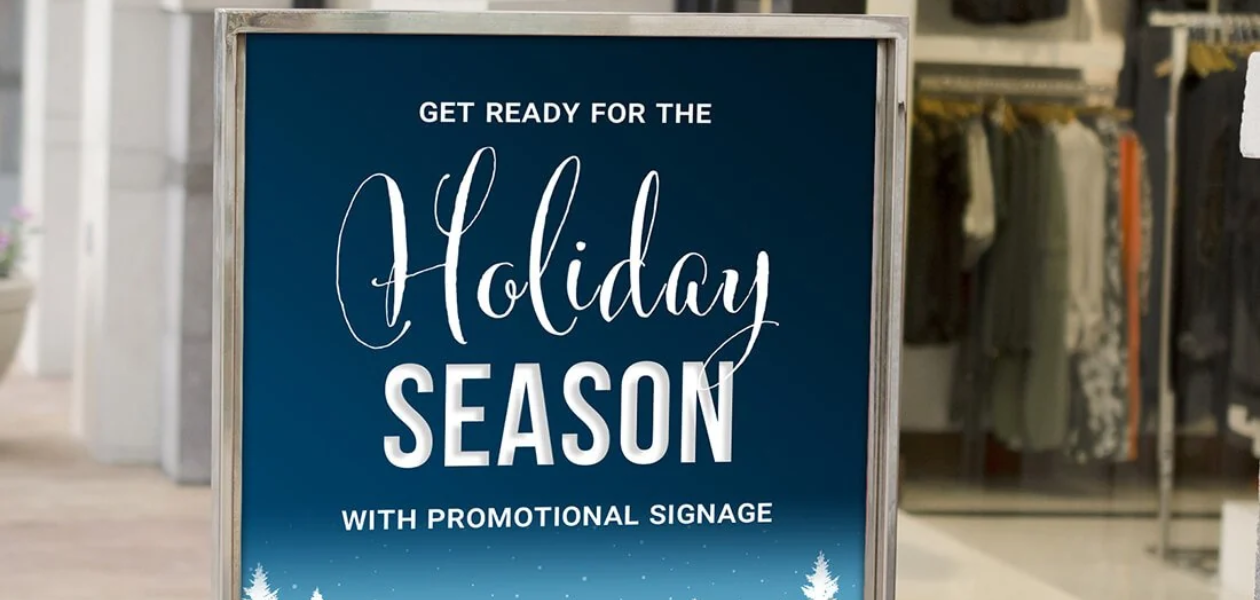
- The sidewalk. A-frames and sandwich boards catch people walking past the entrance rather than toward it. Note that placing anything on a public sidewalk may need municipal permission, and the rules differ from one municipality to the next.
- Overhead. Hanging banners and ceiling-suspended graphics divide a floor into departments or campaigns and are visible from the door. They need mounting points, which is a fixture question, not a print question.
- Product level. Shelf talkers, counter cards, endcap headers and price callouts. Point-of-sale signs are the highest-quantity and lowest-cost items in the kit, and the ones most likely to be reprinted at the last minute because a price changed.
- Queue and checkout. Floor graphics, stanchion signs and counter-top units, where people spend the most uninterrupted time looking at something.
Outdoor banners and flags sit alongside this for anything that has to read from the parking lot or the road. They have a different substrate requirement than anything indoors, so they are worth quoting as their own line rather than folding into the in-store order.
Why does lead time catch people out?
The press is almost never the bottleneck. Printing a run of shelf talkers takes hours. What takes weeks is everything on either side of it:
- Getting the assets. Final pricing, final offer wording, legal sign-off, and high-resolution versions of whatever product photography the campaign uses.
- Design and layout. One campaign is twenty-odd different sizes, from a shelf strip to a window wrap, and each has its own safe area and viewing distance.
- The proof loop. This is the single most variable step. One round of changes costs days; three rounds with a committee costs weeks. Nothing else in the schedule stretches like this.
- Finishing. Lamination, cutting, mounting, grommets, hemming and hardware assembly all happen after the print and before anything ships.
- Shipping and install. Kitted and labelled per store, shipped, received by someone who is also running a store, and merchandised onto the floor.
Lead times depend on substrate, quantity, finishing and whether the artwork arrives print-ready, so get a current quoted lead time rather than assuming last season's. The one thing that is consistently true: the schedule is dominated by approvals, not production.
How do you build the calendar backwards?
Fix the date the signage has to be visible to a customer, then step back through the chain in this order:
- 1. In-store date. Not the first day of the promotion — a day or two earlier, so staff can merchandise without customers watching.
- 2. Delivery date to each location, with a buffer for a store that misses a receiving window.
- 3. Production release, which is the point of no return. After this, a change means a reprint.
- 4. Final proof approval, with a named person who can approve it and a date they have agreed to.
- 5. Artwork and copy lock, including final prices.
- 6. Measurement and site data, which is the step nobody schedules and everybody needs.
Put a date and an owner on every one of those six. A calendar without a named approver is a wish. And build in one deliberate reprint allowance, because a price or a date will change after production release at least once a year.
What should you buy once and reprint?
The biggest avoidable cost in campaign signage is buying the hardware again every time you change the message. Most of the kit splits cleanly into a durable frame and a disposable graphic:
- A-frame bodies with slide-in or snap-in inserts — the frame lasts years, you print the panel.
- Banner stands, rails and overhead hardware — reuse the hardware, reprint the banner.
- Snap frames and poster holders at the counter and in the queue, which a store associate can change in a minute without tools.
- Shelf and rail channel sized to a standard insert, so the next campaign is a print run and not a fixture project.
Once you are on a hardware system, the per-campaign cost drops to the printed insert, and the changeover becomes something store staff can do rather than a service call. Two things make or break it: standardize on as few insert sizes as you can live with, and store the hardware labelled, in one place, rather than discovering in March that half the A-frames went missing after the holidays.
What breaks on a rollout across many stores?
At one location, a seasonal order is simple. Across forty, the failures are logistical rather than creative:
- Stores are not identical. Window sizes, ceiling heights and fixture types vary, so one window file does not fit every store. This is why the measurement step matters.
- Kitting. Each store needs its own labelled box containing only its pieces, with a simple sheet showing what goes where. Shipping one bulk carton to a region guarantees the wrong store gets the wrong window print.
- Spares. Something arrives creased or gets torn during install. A small overage on the high-risk pieces costs far less than a rush reprint.
- Verification. Ask for a photo from each store once the kit is up. It is the only way to know the campaign is actually live everywhere you paid for it.
Managing this across provinces is ordinary work for a supplier that already runs national multi-site rollouts, and it is genuinely difficult to run out of a marketing inbox.
What should you do in the quiet weeks?
The work that makes the next three campaigns fast is all off-season work. Measure and photograph every window, door and fixture position in every store, and keep the file. Build a template library at the sizes you actually use. Lock the names you use for zones and promotions so artwork files do not have to be renamed every cycle. Then decide which pieces are permanent and which are campaign items — because permanent signage should be specified once, properly, and not reordered four times a year alongside the seasonal print.
The Bottom Line
Seasonal signage is cheap to produce and expensive to rush. If the artwork is approved on time, the in-store kit is one of the lowest-cost marketing items you buy; if it is approved late, you pay for express production, express freight and a promotion that runs with half its signage. The fix is a backwards calendar with named approvers and a hardware system you are not rebuying every season. Calibre Signs has been doing this for more than 30 years as a Canadian-owned manufacturer, with design, fabrication and install in house, certified and WSIB-compliant crews, permits handled in house, and multi-site rollouts across the country.
Ready to get started? Send us your campaign dates and store list and we will work the schedule backwards with you before anything goes to print. Get a quote.